
Say ‘No’ to AI Data Centres in Vancouver
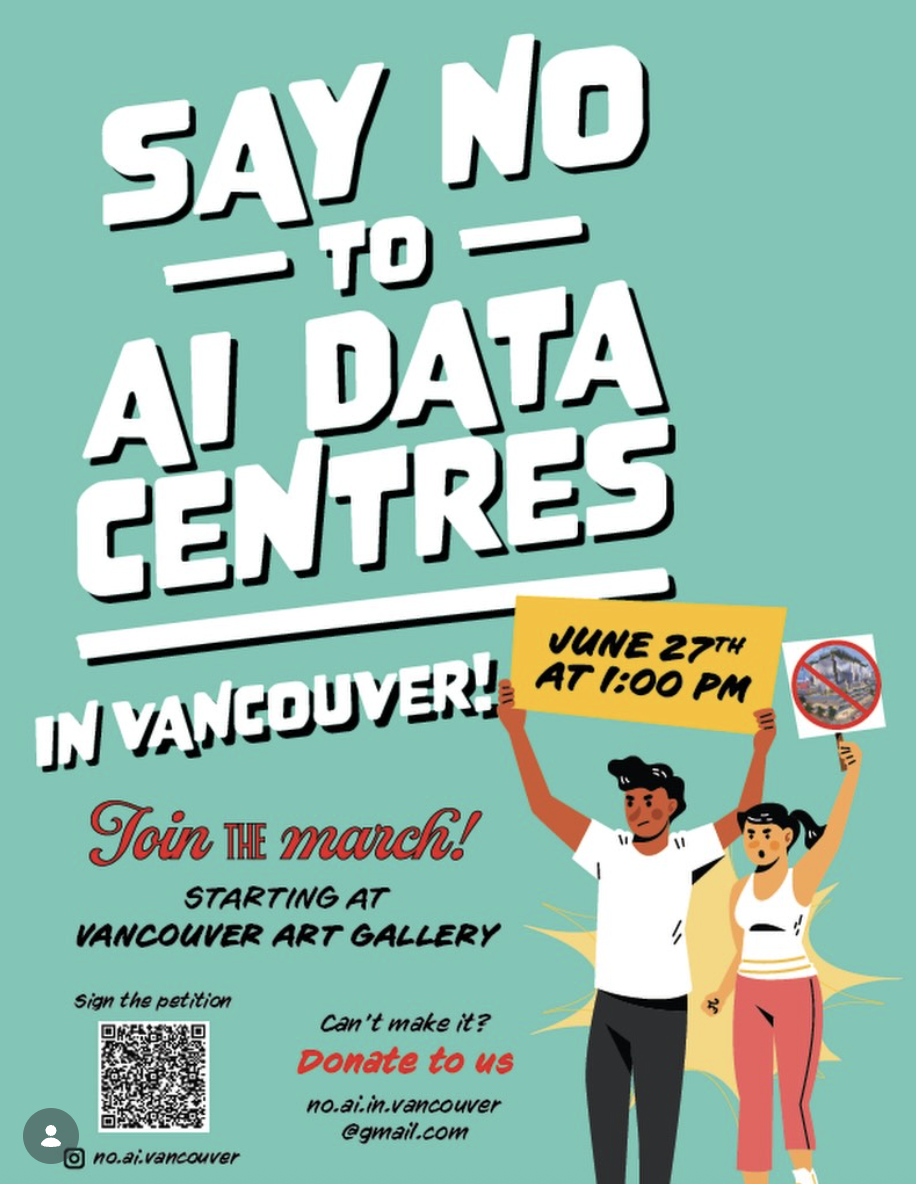
Join us in protesting against the ai data centres being built in Vancouver on June 27th at 1:00 pm starting at the Vancouver Art Gallery!
This protest is in response to the sudden announcement of two massive AI data centre projects pitched by Telus and Westbank (one at the former Hootsuite HQ in Mount Pleasant, and another 10-story facility slated for 150 West Georgia Street). While the federal government pushes its "sovereign AI" strategy, locals are looking at the stark physical realities of these facilities. Vancouver residents are pushing back for several key reasons
1. Water
The timing of these data centre proposals couldn't be more hypocritical. Metro Vancouver has just been forced into Stage 3 water restrictions for the first time in 11 years—meaning a total ban on lawn watering, filled pools, and residential car washes.
Why are things so dire? It’s a perfect storm. The region's mountain snowpack melted a month early, municipal water workers (GVRDEU) are currently on strike picketing reservoirs, and Metro Vancouver has taken a major water line offline due to the massive, ongoing Stanley Park Water Supply Tunnel project. Because water routing is crippled while they dig this new tunnel under the park, the city is desperately trying to protect water pressure for emergencies.
Yet, behind closed doors, tech giants are planning data centres that require millions of liters of water daily to keep processing chips from melting. While corporations claim they will use "closed-loop" systems, these facilities still rely heavily on freshwater evaporation during hot, dry summer months—precisely when Vancouver’s crippled water system is at its absolute limit. Residents are asking a simple question: Why are citizens being told to ration every drop while secretive tech projects are given a green light to guzzle the public supply?
2. Land & Power
Vancouver is one of the densest, most expensive cities in North America, currently facing a severe housing crisis. One of the loudest complaints from protestors and local city councillors is the sheer waste of prime urban land.
Instead of building much-needed affordable housing or community spaces, transit-accessible downtown real estate is being allocated to house rows of computers. Furthermore, just one of these proposed 10-story facilities can draw up to 100 megawatts of electricity at any given time—enough power to sustain thousands of homes for an entire year—putting an unprecedented strain on BC Hydro's grid.
3. Pollution
Beyond straining public resources, these proposed data centres pose a hidden threat to Vancouver’s urban air quality. Because these facilities require uninterrupted power, they are packed with dozens of industrial diesel backup generators that spew a toxic cocktail of nitrogen oxides and fine particulate matter (PM2.5) into the surrounding neighborhood during testing or outages, risking severe respiratory and cardiovascular damage for nearby residents. Additionally, the massive plumes venting from cooling towers are not harmless steam; the water is treated with heavy chemical biocides to prevent bacterial growth, creating a toxic mist and fine mineral dust that drifts over local homes, soil, and community gardens. For a population already navigating a severe water shortage and a housing crisis, introducing a massive new source of industrial urban air pollution without any public consultation makes these secretive projects feel like a direct betrayal of local livability.
4. Noise
Data centres aren't just invisible warehouses. They are loud. The constant, high-frequency whine from industrial air-to-water chiller systems and massive backup generators runs 24/7. For residents living in Mount Pleasant and downtown, the prospect of an unyielding mechanical hum vibrating through their neighborhoods is a nightmare for local livability and mental health.
5. Inked in Secret
Perhaps the most infuriating aspect of this development is the complete lack of public consultation.
"I think this really speaks to the grassroots outrage at governments charging ahead, chasing the AI bubble with no community consultation." — Emily Lowan, B.C. Green Party Leader
This has become a glaring, repeatable pattern in high-tech development. These projects frequently bypass standard municipal pathways and community hearings. Because they are framed under federal initiatives (like Ottawa’s Enabling Large-Scale Sovereign AI Data Centres program), they are fast-tracked behind closed doors using non-disclosure agreements and corporate handshakes. By the time the local population even realizes a data centre is coming to their block, the permits are signed, the land is cleared, and it is already a done deal.
We the People
Vancouver is far from alone in this fight; the grassroots action on the streets of Mount Pleasant is part of a global rebellion against Big Tech’s physical footprint. From the United States—where a staggering 71% of Americans now oppose local AI data centers and cities like Monterey Park have passed historic bans—to Europe, where Ireland and the Netherlands have frozen new grid connections to protect their power grids, communities are aggressively pushing back. Across Canada, provinces like Manitoba have canceled major projects due to public outcry, while towns in Ontario and Alberta are actively forming coalitions to legally block developments.
In the words of Manitoba Premier Wab Kinew:
“It's very clear AI is transforming our economy and our society. But I think Manitobans want that to happen in a way where AI serves us and we're not servants to AI. I reject the idea that we have to be slaves to surveillance capitalism in order to participate in the modern economy.”
Clearly AI is here to stay. But building more and more and bigger and bigger data centres is obviously not sustainable. And we the people can say ‘no.’ The Say ‘No’ to AI Data Centres in Vancouver movement is just starting. If you can, show up on June 27. Beyond that, we’ll be sharing upcoming opportunities to join your neighbours in protesting this abuse of power. And I close with one more quote from Wab Kinew:
"I have the feeling that maybe these $30-billion hyperscale data centres are going to be albatrosses in the future, when people can run the AI that's necessary for their day-to-day use on their local MacBook."
Resources
We’ll be adding to this resources list as more come available.
The AI Resist List - We call the companies leading this form of AI development “empires”. Under the guise of a civilizing mission to "benefit all of humanity”, they use large-scale AI development as cover to consolidate resources, destroy ecosystems, centralize information, hollow out institutions, and gain paramount economic and political power.
No AI Vancouver Linktree - Stand up against AI data centres because our city deserves better. Local rallies and protests listed here.