
The Unapologetic Queer Excellence of the Vancouver Goldeneyes
by Robyn Travis
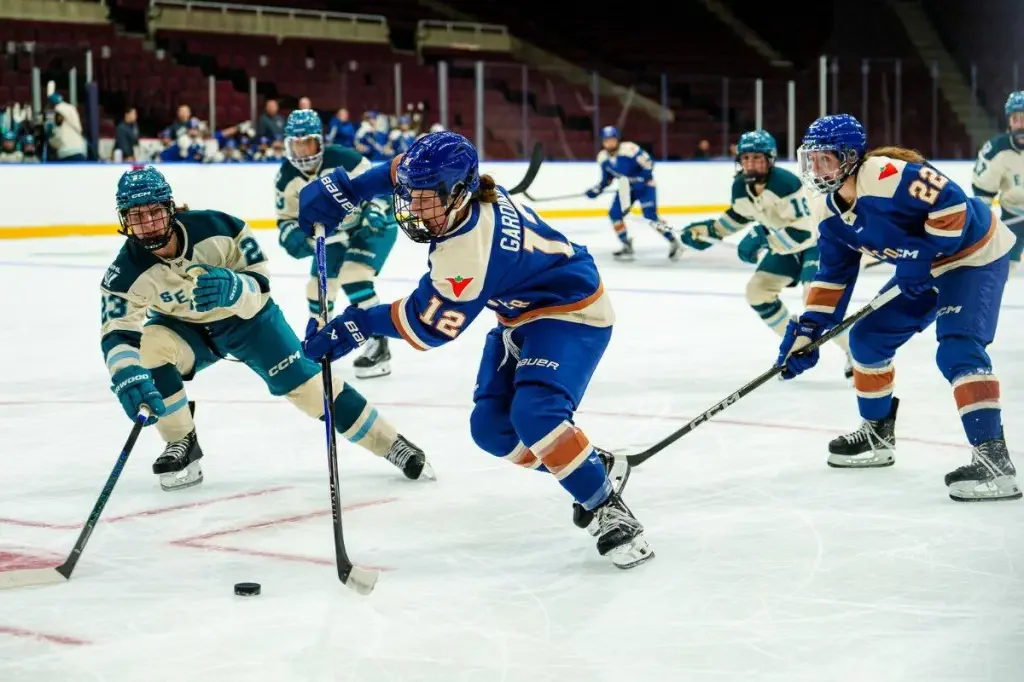
When the Vancouver Goldeneyes stepped onto the ice in the Professional Women’s Hockey League in 2025, it felt like more than the launch of a new team. It felt like a shift. A widening. A crack in something that had been sealed too tight for too long.
The rise of the Goldeneyes represents more than elite women’s hockey. It reflects a broader cultural shift in who gets to belong in sport. At a moment when professional women’s athletics are gaining unprecedented attention and investment, Vancouver’s newest team offers a powerful lens through which to look at the deep and often underrecognized relationship between queer culture and women’s hockey.
This relationship is not new. Queer athletes have shaped women’s sport for generations, even when they were not afforded the safety to name themselves publicly. From local leagues to Olympic podiums, queer players, fans and allies have built hockey spaces grounded in resilience, collective care and community accountability. Women’s hockey has long functioned as a network of chosen family.
What feels different now is the visibility.
Across the PWHL, including here in Vancouver, openly queer players are not hiding or softening their identities to fit into the sport. They are competing at the highest level, building families, loving openly, leading teams. Not coded. Not whispered about. Just present.
Goaltenders Emerance Maschmeyer and Kristen Campbell anchor the Goldeneyes in very different but equally compelling ways. Maschmeyer, an Olympic veteran and queer parent, brings a steadiness to the crease that feels almost architectural. Her visibility off the ice carries as much weight as her glove hand. Campbell’s calm technical precision offers its own quiet authority. Watching them split the net is watching depth, trust and shared responsibility in motion.
Sydney Bard’s physical, unapologetic defensive play adds another layer to the team’s identity. She plays with edge, with intention, with the kind of commitment that reminds you hockey is as much about grit as it is about grace. Michelle Karvinen brings international experience and offensive creativity, a player who reads the ice like a story unfolding in real time. Hannah Miller’s dynamic scoring touch makes her one of those athletes who can change the temperature of a game in seconds.
And yes, Michela Cava and Emma Greco remain part of this broader story of queer presence in the league. The movement of players through trades and roster shifts only underscores something important. Queer visibility in women’s hockey does not hinge on a single couple or headline. It is systemic. It travels with the athletes wherever they go. The culture is bigger than any one team.
The PWHL has reinforced that culture intentionally. Pride Unity Games. Queer and trans artists designing league logos. Partnerships that extend beyond a single themed night. These gestures signal that queer identity is not decorative in women’s hockey. It is structural.
Then came the 2026 Milano Cortina Winter Olympics.
The women’s hockey final, USA versus Canada, ended in a dramatic 2 to 1 overtime gold medal for the Americans. It was fast. Technical. Relentless. It showcased the depth of a sport that has been building toward this level of recognition for decades. The tournament also featured one of the most openly 2SLGBTQIA+ groups of athletes in Winter Olympic history. Queer players were not peripheral to the narrative. They were central to it.
For viewers at home, especially queer youth, that kind of visibility lands differently now. Women’s hockey has always contained queer excellence. What has changed is the permission to be visible without apology.
Back in Vancouver, that Olympic energy now folds directly into the second half of the Goldeneyes’ inaugural season. The team returns from the Olympic break on March 1, launching the back half of the year with international momentum behind them. The timing feels symbolic. The global stage amplifies the sport and the local arena carries it forward.
If you have been to a Goldeneyes game, you already understand what makes this moment feel distinct.
The Pride flags. The couples holding hands. The aunties. The youth teams serenading the arena. The baby gays in thrifted jerseys. The way the goal horn feels less like noise and more like a shared pulse. The unmistakable presence of queer joy in the stands.
A friend recently described attending a PWHL game as healing. Not because hockey erases structural inequity, but because feeling safe in a sports arena, and even on the way home, was new. That kind of safety does not materialize by accident. It is cultivated by communities who insist on it.
Through the Goldeneyes’ growing fanbase and the electric energy of Pride nights, hockey becomes more than competition. It becomes a site of belonging. A place where toughness and tenderness coexist. Where collective care shows up in cheers, in visible affection, in the refusal to make anyone smaller than they are.
The Goldeneyes are named after a fast, resilient coastal bird. There is something fitting in that. Across the PWHL and now across Olympic ice, queer representation is not the exception. It is foundational.
As the second half of the season begins, Vancouver is not simply watching a team chase playoff positioning. We are witnessing a cultural moment. One where queer culture is not an add on to professional sport, but a foundational force in building vibrant, sustainable hockey communities.
Women’s hockey right now feels like more than a game. It feels like a living archive of participation, persistence and joy.
And as the puck drops again on March 1, the message feels clear.
The ice is wide enough.
Robyn Travis is an artist, writer and librarian based in so-called Vancouver who ruminates about queer belonging and the small moments that make community feel electric. Probably overthinking a sentence or underlining something important. Robyn’s Portfolio Here.