
French Social Etiquette: Small Habits That Shape First Impressions

Walk into a small shop in France, ask a question immediately, and the exchange may feel colder than expected. Add a simple “Bonjour” first, and the tone can change completely. Small social habits often carry more weight than visitors realize.
The same applies to friendships, work, travel, and relationships. Someone interested in dating french women may focus on conversation or chemistry, but first impressions can also depend on details such as greetings, formality, timing, and how directly a person speaks.
None of these habits describes every French person. Region, age, family background, and personality matter. Still, understanding a few common social expectations can make interactions feel less confusing and reduce mistakes that have little to do with actual dislike.
A greeting usually comes before the request
One of the easiest mistakes for visitors is beginning with the practical part of the interaction.
Imagine entering a bakery and saying:
“One baguette, please.”
The sentence is polite in English, but in France the missing greeting can make the exchange feel abrupt.
Starting with “Bonjour” during the day or “Bonsoir” later is often expected in small shops, cafés, reception desks, and many everyday service situations.
The pattern is simple:
Greet the person.
Make the request.
Say thank you.
Say goodbye when leaving.
This may feel formal to someone from a culture where customers often move directly to the order. In France, acknowledging the person before discussing the transaction often matters more.
“Tu” and “vous” signal the relationship
English speakers do not have to think much about formal and informal versions of “you.” French speakers do.
“Vous” is commonly used with strangers, older people, professionals, and in more formal settings. “Tu” is used with friends, family members, children, and people who have agreed to speak more informally.
The safest choice with a new adult acquaintance is usually “vous” until the other person suggests switching.
Moving to “tu” too quickly can sound overly familiar. Staying with “vous” forever can also create unnecessary distance once the relationship has become casual.
The change itself can be social. Someone may simply say that you can use “tu,” which signals that the interaction has become less formal.
First meetings may feel reserved without being unfriendly
Visitors sometimes interpret French social reserve as disinterest.
A new acquaintance may not ask many personal questions immediately. Service staff may not use the same enthusiastic tone common in parts of North America. Strangers may keep more emotional distance during the first interaction.
That does not mean the conversation is going badly.
French politeness can place more emphasis on correct tone and respectful distance than on obvious friendliness.
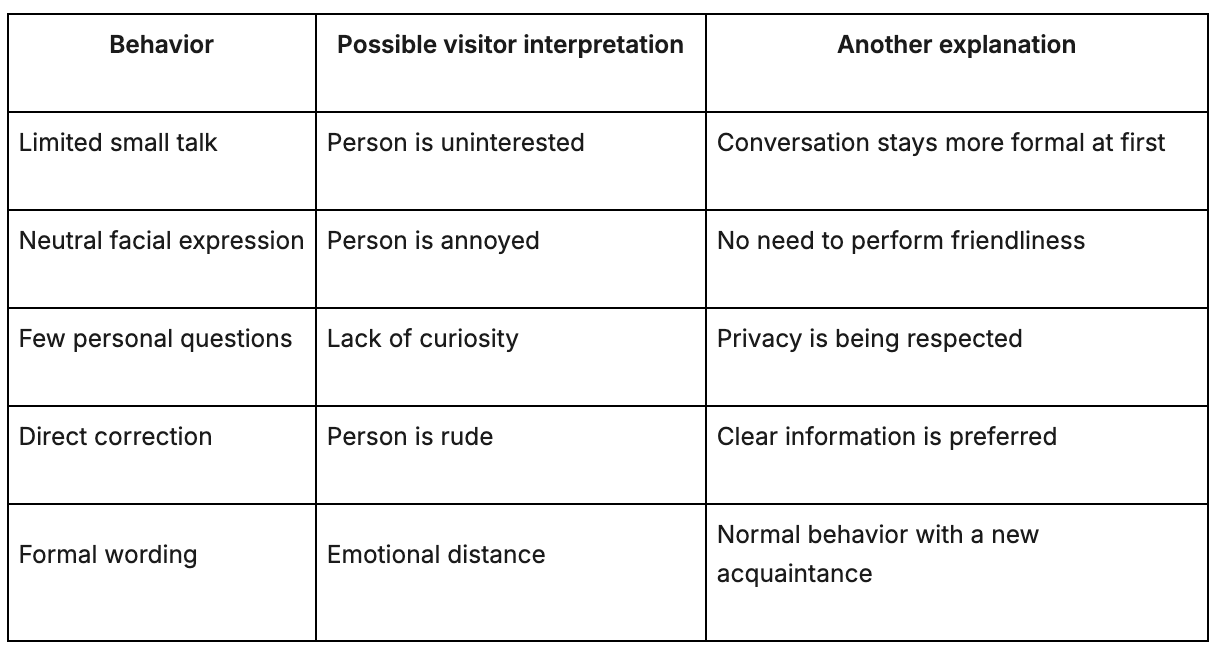
Context matters more than one gesture.
La bise depends on the situation
The cheek-kiss greeting, commonly called la bise, is one of the most visible French social customs. It is also easy for visitors to misunderstand.
The number of kisses can vary by region and social circle. Not every person uses the greeting in every situation. Professional settings may involve a handshake instead, and first meetings between strangers do not automatically require cheek kisses.
The best strategy is observation.
If someone moves toward a cheek greeting, follow their lead. If they offer a hand, use the handshake. When uncertain, there is no need to force the ritual.
Trying too hard to imitate local behavior can be more awkward than admitting that you are unfamiliar with it.
Conversation can include more disagreement than visitors expect
French social conversation may allow stronger disagreement than some visitors are used to.
People can challenge an opinion, ask for justification, or disagree directly without considering the exchange hostile.
A discussion about a film may turn into a debate about politics, education, or food. Someone saying “I don’t agree at all” may be interested in continuing the conversation rather than ending it.
The important distinction is between disagreement and personal attack.
Challenging an idea is one thing. Dismissing the person is another.
For visitors, the useful habit is to avoid assuming that every strong opinion signals conflict. Listen to tone, watch how the group responds, and notice whether the conversation continues normally afterward.
Compliments are better when they are specific
Compliments can work well in French social settings, but excessive praise may sound less sincere.
A simple comment about someone's jacket, cooking, apartment, or choice of restaurant is usually easier to receive than repeated personal admiration.
Specificity helps.
“You chose a great place” feels grounded in the situation.
“You have incredible taste in everything” may sound exaggerated when two people barely know each other.
The same applies in dating. Compliments about appearance are common, but making the entire conversation about looks can become shallow quickly.
Observation and moderation tend to work better than intensity.
Punctuality depends on context
Time expectations can differ between professional and social situations.
For work meetings, appointments, transport, and reservations, arriving on time matters.
A private dinner or gathering at someone's home can be more flexible, depending on the host and social circle. Arriving several minutes after the stated time may be normal in some situations, while showing up very early can create inconvenience if the host is still preparing.
The easiest solution is to ask when the setting is unclear.
If someone says dinner begins at eight, a quick “Should I arrive exactly at eight?” can remove uncertainty.
Meals have their own social rhythm
Lunch or dinner with other people is often treated as a real social occasion rather than something to finish quickly.
Conversation may continue after the main course. Coffee can come later. Nobody may appear in a hurry to leave.
If you are invited to someone's home, waiting for the host before beginning is usually safer than immediately starting to eat.
Bringing something small can also be appropriate, but context matters. Flowers, chocolates, or another simple gift may work well depending on the relationship. Turning up with an expensive gift can create unnecessary formality.
At restaurants, the social expectation is often to stay present in the conversation rather than checking a phone constantly.
Privacy matters more than many visitors expect
Some subjects are better introduced gradually.
Salary, personal finances, family conflict, religion, romantic history, and political views may be discussed, but not every topic belongs in the first ten minutes of meeting someone.
French conversation can be intellectually open while personal life remains private.
That distinction surprises some visitors.
A person may happily argue about a public issue while giving very little information about their income or family relationships.
If an answer becomes short or vague, changing the subject is usually better than pushing for detail.
Small mistakes matter less than social awareness
Visitors do not need perfect French etiquette.
Using the wrong pronoun once, hesitating during a greeting, or misreading when to shake hands will rarely ruin an interaction by itself.
What matters more is noticing how people around you behave.
A practical approach is:
Start with a greeting.
Use the more formal option when unsure.
Watch how people greet each other.
Match the level of personal detail being offered.
Ask when a social rule is unclear.
This keeps etiquette from becoming a rigid checklist.
First impressions are built from many small signals
French social etiquette often works through details that are easy to miss: greeting before asking, using the right level of formality, giving people some privacy, and paying attention to the setting.
None of those habits guarantees that two people will like each other.
They simply remove unnecessary friction.
Once the basics are handled, the conversation can move to more interesting things: humor, opinions, food, work, travel, personal stories, and the individual habits that matter far more than any national rule.