
Why Losing Can Make You a Better Gamer
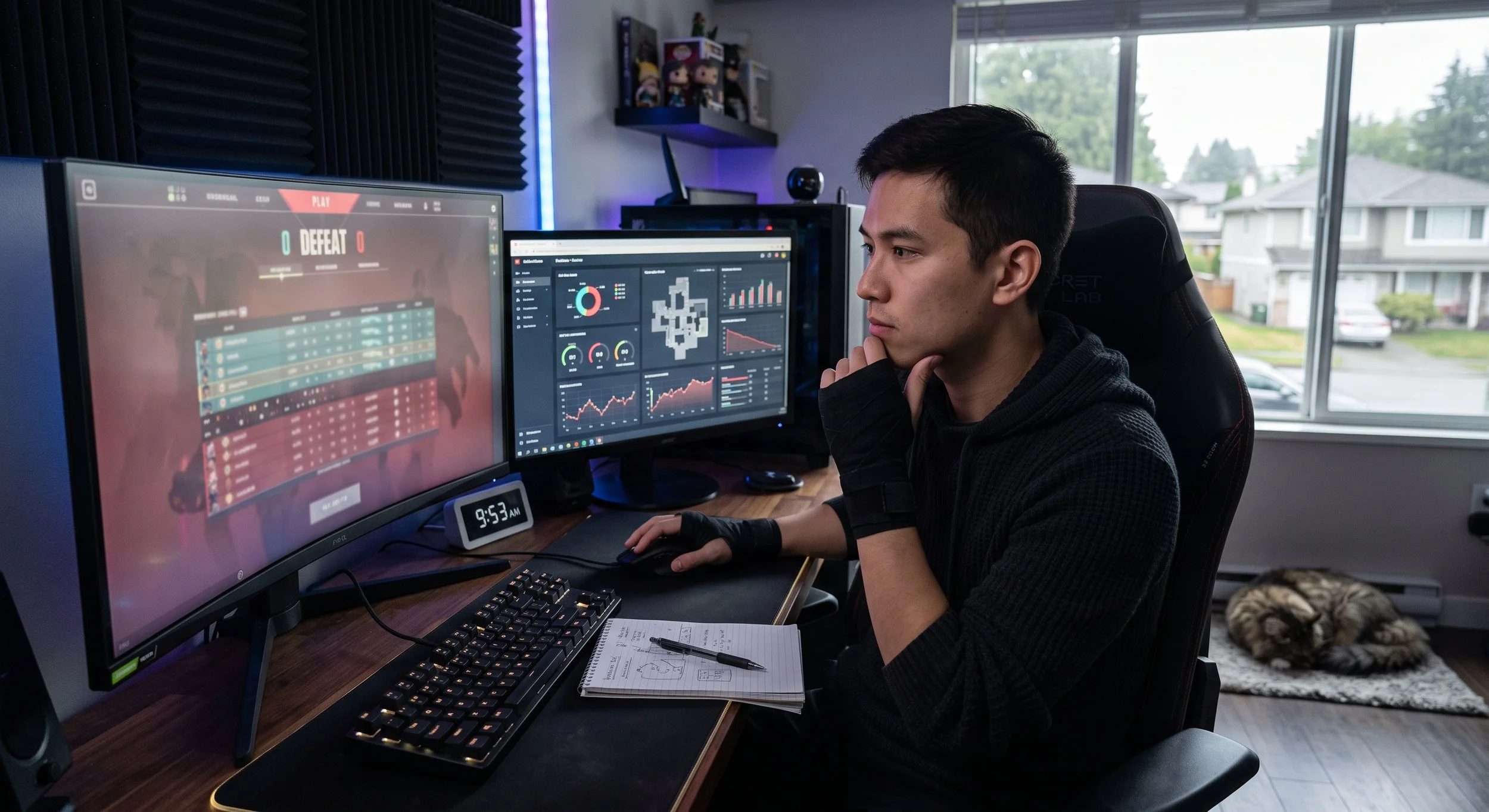
Why Losing Can Make You a Better Gamer
Nobody queues up hoping to lose. But if you've spent any real time in ranked lobbies, you already know that your worst matches often teach you more than your best ones ever did.
That's not just a nice thing to tell yourself after a rough loss streak. It's backed by actual research into how the brain learns, and it's the exact mindset that separates pro players from everyone else stuck in the same rank for months.
Let's get into why losing works, and how to actually use it instead of just raging at the screen.
Your Brain Learns More From Losing Than Winning
There's a reason that gut-punch feeling after a close loss sticks with you longer than a clean win does. A 2025 review in Current Biology explains that dopamine's role in learning comes from something called reward prediction error — basically, the gap between what you expected to happen and what actually happened.
When you expect to win a fight and lose it instead, that gap is huge. Your brain registers it as a signal worth paying attention to. A win you expected? Barely a blip. Your brain already knew that was coming, so there's nothing new to learn from it.
This is why the most frustrating losses are often the most useful ones, assuming you actually sit with them instead of tilting straight into the next queue.
Productive Failure vs. Demoralizing Failure
Not every loss is created equal, though. A 2024 study on gamified algebra learning found that failure boosted what researchers call "productive persistence" — players kept engaging in ways that actually supported learning, rather than just quitting after a setback.
Compare that to what happens with a fixed mindset. Research on serious games found that players who saw failure as proof they simply weren't good enough were more likely to quit or even cheat rather than adjust their approach. Growth-mindset players, meanwhile, sought out more challenge, paid closer attention to their mistakes, and actually read the feedback the game gave them.
The difference isn't talent. It's whether you treat a loss as information or as a verdict on your worth as a player.
Pro Players Don't Fear Losses — They Mine Them for Data
Watch any high-level esports scene and you'll notice something: nobody at the top is pretending losses don't happen. They're obsessing over them.
In a 2024 coaching podcast, one coach described the review process bluntly, focusing on "where you lost your stock and the decisions that led up to that," not just the final scoreline. That's the whole philosophy in one sentence. The loss itself isn't the point. The decision chain that caused it is.
This pattern shows up everywhere in competitive gaming:
League of Legends, VALORANT, CS2, and Dota 2 pros all lean on VOD review to isolate the exact moment things fell apart.
Coaches like TES's Homme have talked about how the period right after a defeat is especially hard mentally, which is exactly why having a clear process (not blame) matters so much in that moment.
Even at the international level, players connect losses to specific, fixable gaps. FlyQuest's Inspired noted after MSI 2025 that improving in North America felt harder because opponents weren't punishing mistakes enough in practice, which slowed down the feedback loop players rely on to get better.
Notice what's missing from all of this: nobody's saying "I lost because I'm bad at this game." They're saying "I lost because of this specific decision, at this specific moment, and here's what I'm changing."
Why This Matters More Than Ever in 2026
Competitive gaming isn't a niche hobby anymore. The ESA reported that 212.3 million Americans played video games weekly in 2026, up 3% from the year before. A huge chunk of that time is spent in ranked, competitive, performance-driven modes.
Just look at current Steam charts. Counter-Strike 2, Dota 2, PUBG, Rainbow Six Siege, Overwatch, Rocket League, Street Fighter 6 — these games live and die by their competitive scenes. Millions of players are grinding rank every single day.
And yet retention data tells an uncomfortable story. A 2025 Newzoo report found most player attrition happens in the first four weeks before flattening out around week twelve. Translation: a lot of people quit right when losses start piling up and frustration outpaces improvement.
It gets worse when you factor in technical issues. A 2025 Liquid Web study found 78% of gamers had rage-quit due to high latency, and 55% had abandoned a game entirely because of lag. Fast-paced genres like FPS and battle royale are especially unforgiving here, which makes it even harder to tell a "real" skill-based loss from one caused by bad connection or unlucky matchmaking.
That distinction matters. Not every loss deserves the same reflection. Some are noise. Some are signal.
How to Actually Turn a Loss Into Improvement
Here's the practical part. Reflecting on a loss without a system usually just means replaying the worst moment in your head on repeat, which helps nobody.
Instead, treat every rough loss like a mini investigation. Start with one question: what repeated pattern caused this? Not "I got outplayed," but something specific enough to actually fix, like "I keep over-extending after getting one kill" or "I ult too early in every close team fight."
From there, separate mechanics from decisions. A missed shot is a mechanical issue. Pushing into a bad angle with no information is a decision issue. They need completely different fixes, and lumping them together just muddies your practice.
This is exactly where match history and stat tracking earn their keep. Memory is a terrible record-keeper — you'll remember the most emotionally painful loss way more vividly than the quiet pattern repeating across your last twenty games. A tool like Battlelog solves that by letting you actually pull up your match history instead of relying on gut feeling, so you can see whether a bad game was a one-off or part of something bigger.
Tracking performance over time also makes recurring issues obvious in ways single-match memory just can't. Late-game throws, weak opening rounds, specific map weaknesses, tilt after a losing streak — patterns like these only show up when you're looking at trends, not just your last match. That's the real value of stat tracking through something like Battlelog: it turns "I think I struggle on this map" into a confirmed, fixable data point.
There's also a motivation angle here that's easy to overlook. When the scoreboard looks ugly, it's tempting to assume you're not improving at all. But a stat-tracking platform can surface small, real gains — a better KDA trend, fewer late-round deaths, improved win rate on a specific agent — even during a rough stretch, which keeps you accountable without spiraling into self-punishment.
The Nuance Nobody Talks About
None of this means losing is automatically good. If every defeat sends you into a frustration spiral where you stop analyzing anything and just queue up angry, the learning value disappears completely. Tilt breaks the entire feedback loop — once frustration takes over, you're not extracting lessons anymore, you're just generating noise.
Burnout is a real risk too. Constant optimization without any breaks tends to backfire, both for pro players and for anyone grinding ranked solo. The goal isn't to obsess over every single loss forever. It's accountability without self-punishment: review, adjust, move on.
And plenty of losses genuinely aren't your fault. Bad matchmaking, smurfs, connection issues — these create fake feedback that can teach you the wrong lesson entirely if you're not careful about separating skill-based losses from technical ones.
The Takeaway
Winning feels great, but it rarely tells you much. Losing, when you actually sit with it and look for the pattern instead of the pain, is where the real improvement happens.
Pro players already know this. They don't fear bad games, they review them. With match history and performance tracking through platforms like Battlelog, that same process is available to anyone serious about actually climbing rank instead of just grinding in circles.
Please play responsibly. The 2SLGBTQiA+ community is known to be at higher risk for gambling-related harm due to a range of social and economic factors. If you or someone you know is struggling with gambling, there are support services available in British Columbia. Contact the BC Gambling Support Line at 1-888-795-6111, available 24/7, or visit www.bcresponsiblegambling.ca for confidential help, information, and free counselling