
Affirming Touch: The Critical Role of Massage Therapy in Post-Gender-Affirming Surgery Recovery
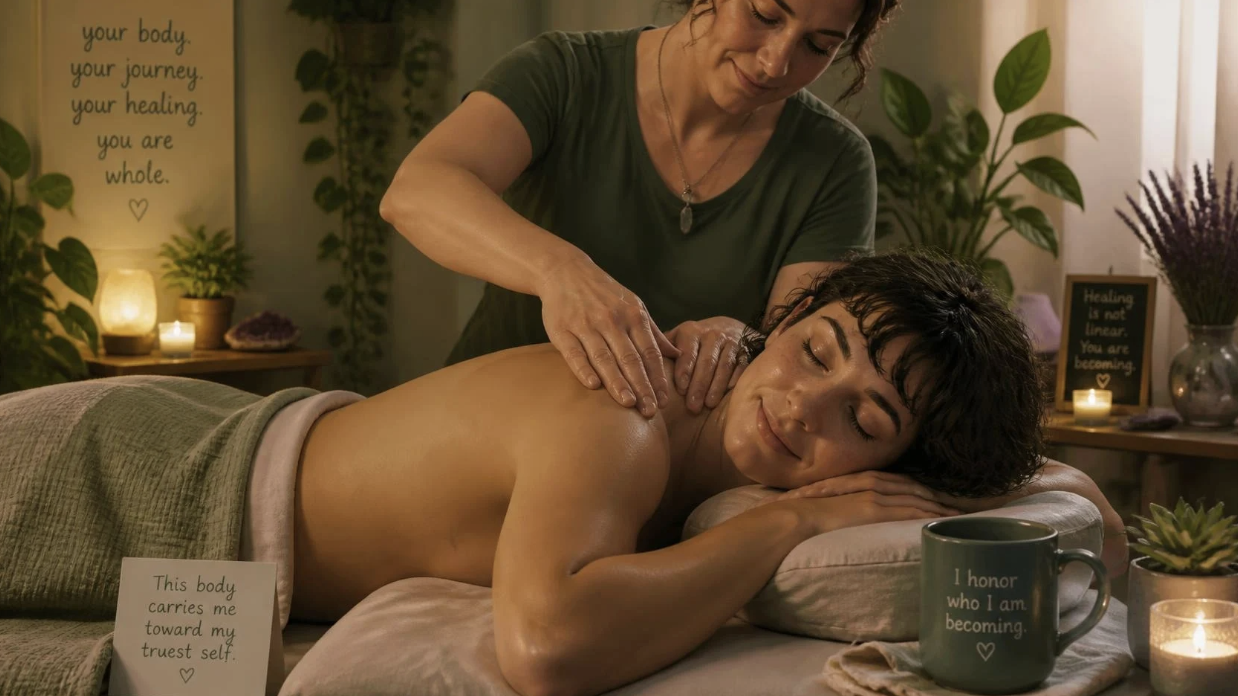
The surgery is the part everyone talks about. The date gets circled, friends organize meal trains, and someone inevitably shows up at the apartment with far too many popsicles.
Then week three arrives, the drains are out, the excitement has worn off, and recovery becomes something much less photogenic: tight scars, swelling that will not settle, numb patches, and a body that feels correct in the mirror and strange to the touch. That stretch of the process gets almost no airtime, which is unfortunate, because it is the stretch where hands-on care makes the biggest difference.
Massage therapy is not a nice extra bolted onto surgical recovery. Used at the right point, with the right practitioner, it changes how scars settle, how quickly swelling clears, and how long it takes before a person feels at home in their own skin again.
First, and this matters: wait for clearance
Nothing below applies until a surgical team says so. Scar mobilization on tissue that has not finished closing can separate a wound, and post-operative timelines vary enormously between procedures and between surgeons. Chest surgery, vaginoplasty, and phalloplasty each carry different restrictions, and the same procedure done by two different surgeons can come with different instructions.
The standard advice is to ask directly at a follow-up appointment: when can scar massage begin, how much pressure is safe, and are there areas to avoid entirely. Most surgeons are happy to answer and rarely volunteer it unprompted. Trans Care BC maintains post-operative care information for people in the province and is a reasonable place to check expectations before an appointment, so the conversation starts from something concrete.
What scar work actually does
Scar tissue is not simply skin that healed. Collagen laid down during repair is disorganized compared to surrounding tissue, and without movement it tends to adhere to the layers beneath it, tethering skin to fascia and sometimes to muscle.
The results show up in ordinary movement. After chest masculinization, a tethered incision line can restrict reaching overhead or pull uncomfortably during a stretch. After abdominal donor-site work, adhesion can affect posture and core mechanics. The tissue does not soften on its own once it has set.
Scar massage works by applying gentle, sustained pressure across and along the incision line, encouraging the collagen fibres to reorganize and the layers to glide independently again. The technique is unglamorous: small circles, light drag, a few minutes at a time, repeated most days over months. Scars remodel for a full year or longer, so early results are not the whole picture, and consistency beats intensity by a wide margin.
A registered practitioner can also spot the difference between a scar that is remodelling normally and one heading toward hypertrophic or keloid formation, where earlier intervention matters. In British Columbia, registered massage therapists are regulated professionals, and the College of Massage Therapists of British Columbia maintains a public register that lets anyone verify a practitioner before booking.
Swelling, lymph, and the long middle stretch
Post-surgical swelling has a rhythm that surprises people. It peaks, subsides, and then returns in the evenings or after a long day on the feet, sometimes for many months.
Manual lymphatic drainage is a specific, very light technique that works with the lymphatic system rather than the muscles, using slow strokes and almost no pressure to encourage fluid toward functioning lymph nodes. It looks like it should not be doing anything. It is one of the more effective tools available for post-operative edema, and it is widely used in surgical recovery well outside trans health contexts.
Anyone booking this specifically should ask whether the therapist has training in lymphatic drainage rather than assuming a general massage practice includes it. The techniques are genuinely different, and deep tissue work on a swollen post-surgical area is counterproductive.
The part about sensation, and the part about pleasure
Nerves regenerate slowly, roughly a millimetre a day under good conditions, and sensation after major surgery returns in an uneven, unpredictable pattern. Areas come back before others. Some spots stay numb. Some go through a period of hypersensitivity where light contact registers as unpleasant before settling into something ordinary.
Gentle, regular touch during that window appears to help the nervous system remap the area, and it also does something less measurable. After months of a body being handled clinically, poked at in appointments, and assessed by strangers, being touched in a context that is neither medical nor evaluative resets something.
The World Professional Association for Transgender Health Standards of Care recognize sexual health and function as part of surgical outcomes rather than an optional afterthought, though clinical services are still catching up to that framing in practice. Sensual and erotic bodywork practitioners, meanwhile, have been working with consent scripts, boundary negotiation, and non-goal-oriented touch for decades. It is worth noting that agencies offering the best tantric massage at body to body london clients typically run explicit pre-session conversations about limits and no-go areas as a matter of standard practice, which is a level of consent architecture that plenty of clinical settings could stand to borrow. Whatever the setting, the useful principle is the same: a person recovering should be the one setting the terms, out loud, before anything begins.
Finding a practitioner who will not make it weird
The practical question most people actually want answered is how to find someone competent who will not require a forty-minute explanation of what the surgery was.
A few things are worth asking on the phone before booking. Whether the practitioner has worked with post-surgical scar tissue before. Whether they have worked with trans clients specifically. How draping is handled and whether the client can keep any garment on that they prefer to keep on. Whether the intake form has a field for chosen name and pronouns, which is a small detail that reveals a lot about the rest of the practice.
Community recommendations tend to be more reliable than directories here. Local queer health networks, surgical support groups, and peer navigators usually know which practitioners in a given city have earned the referral, and word travels fast in both directions.
Recovery is longer than the calendar suggests
Most surgical timelines quote six weeks to return to normal activity, and technically that is accurate. Scars keep changing for a year. Swelling comes and goes for months. Sensation arrives on its own schedule and refuses to be rushed.
Building regular bodywork into that longer arc, rather than treating recovery as something finished the moment the follow-up appointment is done, tends to produce better scars, less stiffness, and a considerably shorter distance between the body in the mirror and the body that feels like home.
That last part is the whole point of the surgery. It deserves the same care as the first six weeks got.