
What Holds Us: On relationship, resistance, and the revolution that begins within

What Holds Us: On relationship, resistance, and the revolution that begins within
by Clayre Sessoms, RP, CCC, ATR-BC
There is a particular kind of tiredness that builds slowly and comes from everywhere at once.
It's in the news you open before you're fully awake, the headline that lands before you've had a chance to steady yourself. It's in the media story that gets it wrong again, or treats your life as a debate. It's in the carer who means well but doesn't quite see you, the authority figure who was supposed to protect you but looked the other way, the stranger on the street who asks a question that reminds you that you are still, to some people, a curiosity rather than a person.
None of these things, on their own, might feel like much. They’re expected, sometimes. But together, over time, they accumulate. They ask something of you that you don’t always have. And they can make even an ordinary Tuesday feel like you are navigating something invisible that everyone else seems to move through without noticing.
I know this from the inside, not just as a therapist, but as someone who is trans, girlflux, queer, disabled, and neurodivergent. Like some of you, I carry all of that into every space I enter.
The long wait
One of the most honest things I can tell you about seeking affirming care is that it has always taken longer than it should. The wait for a therapist who actually gets it. The wait for a doctor who meets you with respect. The wait for care that stops treating you as an edge case.
All that waiting has real costs. We put off the care we need. We shrink ourselves to fit into spaces that were not made with us in mind. We learn, slowly and sometimes painfully, to scan a room before we enter it. We develop whole interior languages for deciding when it is safe to be ourselves and when it is not.
And because we are so often navigating these systems alone, or alongside others just as tired as we are, we don't always get to say how much of us that takes.
What actually holds us
Here's what I have come to believe, both as a therapist and as someone who has needed support: therapy is not the thing that holds us. Relationship is.
Sometimes that relationship lives in a therapy room. Sometimes it lives in a five-minute text exchange with a friend who gets it. Sometimes it's your chosen family sitting around a table on a Sunday, making food for the week and talking about everything and nothing. Sometimes it's
your partner checking in on you after a hard week. Sometimes it's a community gathering where, for once, you are not the exception. You are exactly who was expected to arrive.
These are not consolation prizes for not having access to care. They are the real care.
What we are doing when we stay in relationship with each other, when we check in, when we show up, when we notice that someone has gone quiet and we reach out, is something ancient and necessary. We are reminding each other that we exist, that we matter, that we are not alone in navigating a world that still, too often, treats us as a problem to fix or a case to be managed.
The work that begins inside
I also believe in the work that begins in how we relate to ourselves. This is the part that can sound like an instruction, so I want to say it carefully: I am not asking you to complete your inner work before you are allowed to take up space, to be in community, to belong somewhere. That is not what I mean. What I mean is something smaller and more personal than that.
There was a point in my own life when I noticed how much of my self-talk was shaped by messages I had absorbed from systems that were not built for me. The ways I told myself I was too much, or not enough, or needed to be quieter, smaller, easier to be around. The ways I leaned into work to be seen as worthy, rather than leaning into my pillow to rest.
That bracing is a way of staying close to what we’ve already survived. And it takes practice, slow and patient and relationally attuned, to learn to put it down. For me, that often starts with humour. The kind that cracks something open just enough to let the light back in, and the people. Someone else might find their way through music, or tears, or by making food for the people they love. We each have our own door. What matters is that we keep finding it.
That practice happened for me in many places, only some of them in therapy rooms. It happened in relationship with my felt sense, in conversations with people I trust, in community spaces where I felt held rather than assessed, and in the quieter moments of noticing, without agenda, that I was still here. And that being here, still, after it all, is itself a form of being held.
The revolution that burns inside
The revolution, as I understand it, begins exactly there. Not only in grand gestures or political acts, though those matter too, but in the noticing. In the small daily choice to stay in relationship with yourself even when everything around you is asking you to disappear. We get through difficult times by choosing, again and again, to show up for each other, even when the world keeps making that harder.
This is how we survive: not by having fixed ourselves first, and not alone. We survive through the small conversations that remind us we are not invisible, through the chosen families who see us whole and love us in our complexity, and through the communities that hold what no single relationship can carry on its own.
And sometimes, yes, through the therapy room too, where a different kind of relationship becomes possible. One that makes room for what hasn’t been said yet, and for the parts of you still learning that you are worth staying with, even through challenging times. If that’s something you seek, I hope you find it. If you aren’t yet sure where to begin, know that you’re not alone.
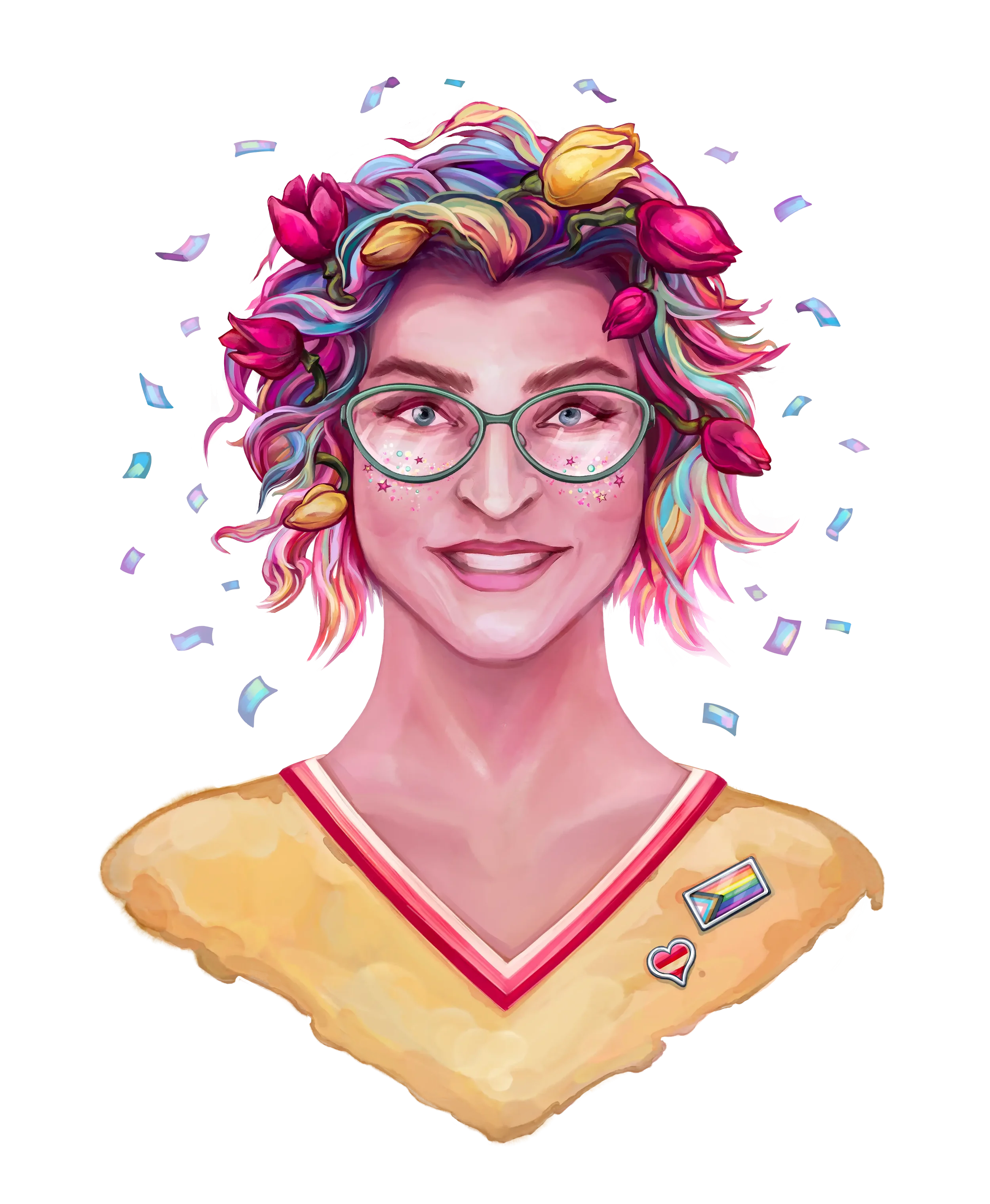
Author’s bio: Clayre Sessoms (she/they) is a white, trans, girlflux, queer, and disabled psychotherapist living and practising on unceded Coast Salish lands. Her work explores how connection, embodied presence, and expressive arts help us reclaim ourselves in systems that have not always known how to care for us. Her work is rooted in justice, reconciliation, and the inner revolutions that make repair possible. She practices relational and experiential therapy alongside Laura Hoge, RSW and Laith Eskandar. Learn more at online therapy practice in BC.