
Vancouver Queer Film Festival 2026 Unveils Its Lineup: What to Expect From This Year’s Festival
Vancouver Queer Film Festival 2026 Unveils Its Lineup: What to Expect From This Year’s Festival
The Vancouver Queer Film Festival returns in September for its 38th edition, bringing 11 days of in-person screenings, shorts programs, community events, and filmmaker-focused activities to Vancouver. The 2026 festival runs in theatres from September 10 to 20, followed by an online program from September 21 to 27. This year’s schedule includes more than 30 listed screenings and events, with stories from British Columbia, other parts of Canada, and international filmmakers.
Film festivals now exist alongside a much larger digital entertainment market. Audiences move between cinema, streaming, social platforms, video games, and other online formats. Adults who choose interactive entertainment can also encounter browser-based casino games through services such as Wintails Casino, while searches for best online сasino belong to the same online gaming category. VQFF takes a different approach to screen-based entertainment: it creates scheduled screenings and shared spaces where audiences can watch films together, meet filmmakers, and discuss the subjects that appear on screen.
The 2026 program reflects that focus. Organizers describe VQFF as Western Canada’s largest queer arts event and Vancouver’s second-largest film festival. Its programming centres 2SLGBTQIA+ stories while placing particular attention on work involving Indigenous people, Black communities, people of colour, and people across different experiences of gender, sexuality, expression, and ability.
The festival opens on September 10
The in-person program starts September 10 with the Opening Presentation, Ecosystems Not Empires, at the Vancouver Playhouse. The screening begins at 7 p.m. and sets up a schedule that continues across several Vancouver venues over the following ten days.
The festival then expands into feature films, documentaries, shorts collections, special presentations, youth programming, and community events.
Organizers use several venues rather than concentrating every screening in one building. The current schedule includes events at the Vancouver Playhouse, International Village, Emily Carr University, Simon Fraser University, and The Cinematheque.
That structure allows VQFF to accommodate different types of programs. A major evening presentation can take place in a larger theatre, while a shorts collection or smaller feature can use a more intimate screening room.
For viewers, it also means that planning matters. Anyone attending several events should check locations as well as screening times before building a festival schedule.
More than feature films make up the program
VQFF has never treated the feature film as its only format. The 2026 schedule continues that approach.
Short films occupy a substantial part of the program, with collections organized around specific subjects and creative approaches. Current listings include Shorts: Drag Darlings, Shorts: Into the Light, Shorts: Joy Ride, Shorts: Rainbows in a Desert, Shorts: Amor(es) Ciego, and Shorts: The Coast is Queer.
These collections give audiences a chance to see several filmmakers during one screening.
Short-form work also serves an important role for emerging directors. A filmmaker does not need the financing or production infrastructure of a feature to develop a complete screen story. That makes shorts an important part of festivals that want to introduce audiences to new voices.
VQFF accepts narrative, documentary, episodic, and other screen formats through its submission process. For 2026, organizers also required creators to disclose the use of artificial intelligence in submitted material and stated that the selection process gives priority to human-created content.
Several presentations anchor the schedule
Three major presentations help structure the 2026 festival.
The opening event takes place September 10. On September 17, Apolo receives the Centrepiece Presentation slot at Emily Carr University’s Reliance Theatre. The screening starts at 7:30 p.m.
The Closing Presentation arrives two days later.
Gugu’s World screens September 19 at 7 p.m. at the Vancouver Playhouse. Although that event closes the main presentation sequence, regular screenings continue through September 20.
A simplified view of the schedule looks like this:
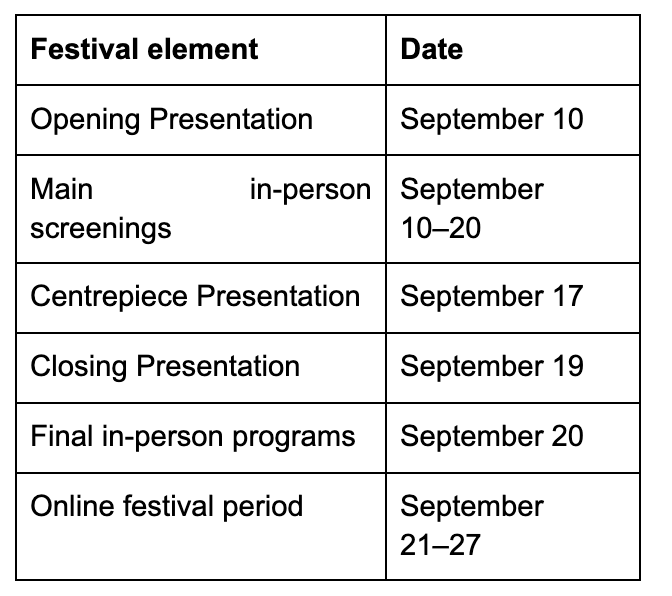
The combination of major presentations and smaller programs gives audiences several ways to approach the festival. Some viewers may choose only the headline events. Others can build a schedule around shorts, documentaries, local work, or particular themes.
The Coast is Queer puts regional filmmaking on screen
One program has a particularly direct connection to British Columbia.
Shorts: The Coast is Queer screens September 18 at 7 p.m. at Emily Carr University’s Reliance Theatre. The program also appears in the festival’s virtual offering.
Regional programming matters because VQFF operates as both an international festival and part of British Columbia’s film community.
The organization behind the event runs activities throughout the year rather than limiting its work to September. Its programs include youth education, industry initiatives, workshops, and community projects.
A local shorts program therefore connects the annual festival with that wider activity.
For audiences, regional selections also create a different viewing context. International films can introduce experiences from distant communities, while BC productions can address locations, institutions, and social questions that viewers encounter in their own province.
Documentary subjects occupy a significant place
The current schedule includes several titles that point toward documentary and nonfiction concerns.
GAYS AGAINST GUNS screens on September 20. Mineshaft: The Cruising Murders appears earlier in the festival on September 11. Other listed programs examine identity, community, memory, and social experience through different forms.
Queer documentary filmmaking has a particular historical function because many communities lacked sustained representation in mainstream film and television for long periods.
Documentaries can preserve testimony, record community organizations, examine political conflicts, or focus on individual lives.
A festival context adds another element. Audiences do not simply encounter a film through an algorithm or isolated streaming recommendation. Programmers place the work alongside other films and events, which can help viewers understand why it appears in that year's selection.
International stories remain central
VQFF does not limit its selection to Canadian productions.
The festival explicitly seeks work from 2SLGBTQIA+ storytellers in British Columbia, across Canada, and internationally. Its submission rules accept films in any language as long as filmmakers supply English subtitles for the programming process.
That international scope expands the subjects audiences encounter.
Legal conditions, family structures, religious contexts, economic circumstances, and public attitudes toward queer people differ considerably between countries. Films can document those differences without treating queer experience as a single universal story.
The 2026 lineup therefore works across several geographic levels: local, national, and international.
That mix also distinguishes a curated festival from a standard commercial cinema schedule. Programmers can select films that may not receive wide theatrical distribution in Canada.
For some titles, VQFF may provide one of the relatively few chances for a Vancouver audience to see them in a cinema.
Please play responsibly. The 2SLGBTQiA+ community is known to be at higher risk for gambling-related harm due to a range of social and economic factors. If you or someone you know is struggling with gambling, there are support services available in British Columbia. Contact the BC Gambling Support Line at 1-888-795-6111, available 24/7, or visit www.bcresponsiblegambling.ca for confidential help, information, and free counselling